In this episode, we talk with Dr. Brian Belardi about his lab’s work on biological barriers in organisms, tissues, cells, and how understanding their molecular and physical properties could enable new therapies and regenerative medicine.
Guests
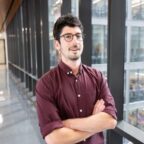 Dr. Brian BelardiAssistant Professor, McKetta Department of Chemical Engineering
Hosts
 Bailey TibbettGraduate Student at the Keitz group
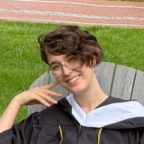 Audrey ColegroveEducation and Outreach Coordinator for the Center for Dynamics and Control of Materials
[00:00:00] Bailey Tibbett: Hello everyone and welcome to the Materials Universe podcast. I’m your host, Bailey Tibbett, and I have with us today our co-host
[00:00:08] Audrey Colgrove: Audrey Colegrove. Hi everyone.
[00:00:09] Bailey Tibbett: and today we’ll be interviewing Dr. Brian Belardi.
[00:00:13] Brian Belardi: Hi there.
[00:00:14] Bailey Tibbett: Sweet. I’m
[00:00:15] Brian Belardi: honored. It’s a pleasure to be here. Um, you can hold the applause. It’s okay.
[00:00:19] Bailey Tibbett: Dr. Ardi is an assistant professor in the mc Mcta Department of Chemical Engineering at the University of Texas at Austin, and holds the Lyonel Chemical Company endowed faculty fellowship in engineering. His lab focuses on building new chemical biology and synthetic biology tools to probe and manipulate tissue properties.
[00:00:37] Audrey Colgrove: Would mind giving us a brief introduction into your research?
[00:00:39] Brian Belardi: Yeah. Hi everyone. Well, thanks for having me. Um, you know, I’m a long time listener of the podcast. And, uh, I’m glad I can contribute too.
Yeah. To all those listeners out there. Yeah. My name’s Brian Belardi. I’m an assistant professor at UT Austin. I started in 2021 here and I started with a very small lab, but we’ve grown quite large and my lab’s interest. Really focus on biological barriers in living organisms. And you can think of biological barriers in a lot of different ways.
An organism itself is a biological barrier. Think about it. You know, if I’m trying to run past you, we’re gonna hit each other and fall down. Um, we’re not gonna be able to traverse one another. Uh, another way of thinking about a biological barrier, the organs that make up of our body plan. So each of the organs is a bi, is a biological barrier.
There’s actually this really. Maybe a bit of a gory experiment, but really an interesting one that helps explain this. So if you ever inject a developing embryo with a dye, let’s just say inject it into its bloodstream, it won’t cross into the brain of the cerebral spinal fluid, so it won’t even get to the brain.
Why is that? Because there are biological barriers there that are blocking it. And I lab also study the biological bears that exist in every single cell in your body. And there are some really fascinating ones that compartmentalize different parts of the cell. So basically there’s biological bears everywhere, and we study them on the molecular scale.
So we try to understand the molecules that make up these barriers. We try to understand the physical properties around the barriers themselves. The hope is that we can manipulate some of these. If we understand them well enough, we can manipulate them for therapy one day or regenerative medicine purposes.
And. We can also maybe think about developing new types of biological barriers from scratch in the laboratory that I’m sure we’ll touch on in the future. My lab runs the gamut of chemist, biologists, engineers, uh, we all utilize our expertise to tackle biological barriers and, you know, we’ve made some progress in the last several years that we’re excited about.
You know, some future, future, uh, applications of our work. We’re trying to develop new pills for oral delivery of biologics, a very exciting class of therapeutic molecules. We’re also trying to develop new materials, new materials for next generation grafts. There are many people out there that are burn victims.
They need a graft to cover up that burn. And that’s a, I’d say, uh, emergency room procedures that doctors have to perform on a daily basis. There are a lot of problems with that technology though. And, um, what we hope to improve that technology by making next generation graft that are easy to use by doctors.
They can cover the entire room and they can change their properties, um, on demand. In a clinical setting. So we’re excited about that as well. We also make, as I mentioned, synthetic cells from scratch. How do we make molecules from, how do we make synthetic cells from scratch that mimic cellular properties?
And how do we combine synthetic cells into higher order assemblies that mimic tissue? Um, and again, we can maybe use these as next generation biomaterials. Again, graphs, filters, adhesives, that sort of things. And another area of the lab is. Thin in the biological barriers that even surround cancer tissue.
So your cancer has a large amount of material around it called the extracellular matrix. We think this is a really, um, underutilized material for both therapy and detection, and we’re trying to take advantage of that. So those are just, that’s a flavor of what my lab works on. Um, you can see it’s, uh, many different topics and that more or less reflects my personal history and background in the sciences.
But, uh, yeah, I think that more or less summarizes it.
[00:04:09] Audrey Colgrove: I have loads of questions about some of those things, but I wanted to start with, would you mind expanding on what y’all mean by synthetic cells in your lab?
[00:04:18] Brian Belardi: Yeah. So, uh, it’s a, uh, in, it’s, it’s an interesting term. It’s a term that was, I would say, coined in the last 10 ish years. Okay. And there’s many different definition in the field, but I think we’re coalescing around a few different definitions. If we’re thinking about a synthetic cell as a living cell, well what are we doing to that living scale?
We’re imparting some unnatural functionalities onto that living cell, basically giving that living cell some ability to do things that it doesn’t, nor isn’t normally able to do. That’s one type of synthetic cell, another type of synthetic cell that my lab is. So we do that absolutely in the lab, but we also are trying to make synthetic cells where we’re making something that’s a cell from scratch.
We basically think about a, a living cell, all the different components and then figure out. Chemical and engineering methods to combine all of those components. Basically the parts that make up the cell together so that we eventually get a cell, but now this cell is not living. It’s under our complete control.
So one thing that differentiates, I think, synthetic cells from living cells or the fact that a. Scientists and engineers, we can impart programmability and control over their processes. You then might ask yourself, okay, sounds cool. Sounds a little sci-fi, right? Uh, why would you ever wanna make a synthetic cell?
Well, again, that’s beautiful that we can control them. We can give them properties that they don’t normally have. These synthetic cells give them the ability to perform acts that they can’t normally do. Uh, so that’s one exciting area. But the other thing is that since they’re synthetic. Especially the ones where we’re building synthetic cells from their component parts in a bottom up way.
They’re not living so we don’t have to keep them alive. So they can have very long, um, half lives, as we would call them. The LA laboratory, they just have, can have infinite longevity. That’s incredible for a lot of applications. It means also that we can use them for applications that would take a long time.
Maybe you want to sense things in the environment over many, many years. We don’t need to keep it alive. It doesn’t need have any nutrients not gonna take up anything to do that. It’ll just maintain itself because of the way we’ve built it and transmit information back to us about its surroundings. I think that brings up an important question and one that you might be anticipating.
Like this is also kind of scary if you’re gonna be deploying these in the environment and in human bodies one day. Um, so there’s a lot of ethical thought that’s put into synthetic cells, and I’m a part of a lot of syn, uh, national Science Foundation panels to think about the technology synthetic cells.
It seems extremely powerful, right? Imagine being able to inject a synthetic cell into your body and it can surveil your entire body, report on the health, and then may be. You can tell this synthetic cell remotely to go to a certain organ or a certain disease or disorder in the body and treat it right.
You could do that also remotely. That’s incredible. But you’re gonna inject this thing into your body, right? How does it not have runaway functionality? Runaway properties will take over your body, right? So there’s a ton of ethical concerns around this, but also ethical opportunities. So as part of this national Science foundation com community called the Build to Sell community, we’re thinking a lot.
[00:07:24] Audrey Colgrove: Sorry. Yeah,
Yeah.
You it sounds like a, uh, a store in the mall you would go to. And that’s also part of the point is that maybe one day this technology can be off the shelf technology. Uh, but the hope is that we. Anticipate a lot of the ethical concerns. So we’ve modeled our ethical discussions around some really famous ethical discussions in science in the 1970s.
[00:07:45] Brian Belardi: There was one as a Sylmar when recombinant DNA technology was being made and there was similar concerns. What happens if these recombinant DNAs get into the environment, organisms taken up and they can take over. Right, humanity and everything else living on earth. That was a real concern because you’re gonna, again, impart or endow cells with something they don’t normally have.
So a lot of our discussions are, we know that could be, you know, a concern. How could we stop it? Right? Can we add safeguards into the technology that we’re endowing cells with? We can shut it off, right? We can anticipate these problems ahead of time. Maybe a kill switch, a self-destruction switch. So we’re thinking about that and basically, every time we’re building in new fun, we call it functionalities.
But again, these are just, you know, different activities that these synthetic cells can reform every time we’re building those into synthetic cells. We also think about the safeguards, right? How are we able to turn these things systems off? Right. So that’s built into the technology now rather than an afterthought at a later point.
So that’s kind of a, a benefit of history, right? That we got to observe sort of what happened with re DNA recombinant technology and now we can apply it to these synthetic cells. It’s a very long-winded answer of everything that, you know, we’re think how you define a synthetic cell, what applications you can use it for, and also some of the ethical concerns.
But I think it just has tremendous potential and it, you know, it excites both the scientific community and people beyond.
[00:09:04] Bailey Tibbett: Yeah, for sure. I think that’s awesome. I feel like the only way to actually fail ethics is to not participate, so I think it’s amazing that you’re like doing that actively while you’re developing this technology because I feel like those concerns are very valid.
Right? Absolutely. But the potential for benefits are there.
[00:09:19] Audrey Colgrove: This is also truly the first time I’ve heard about research in a UT lab that genuinely felt like something out of a science fiction novel. Yeah. Like I, I’m kind of baffled.
[00:09:29] Brian Belardi: I’ve, you know, I’ve given, uh, even talks to, uh, you know, very science heavy audiences. I’ll leave, I’ll get very, you know, particular, uh, sometimes esoteric science questions about the technology, and then I’ll walk around afterwards and people will say, I didn’t think this was even possible. Yeah, right. And yeah, we’re living in an era that I couldn’t even imagine growing up.
You know, in my laboratory, we can create something that would be almost in. Indistinguishable from a living cell under a microscope. You look at the two, you’d think they’re almost the same, and inside that synthetic cell are a lot of the parts in living cells, okay? In all of the living cells in your body.
We have these different processes taking place. We have genomic information that’s getting transcribed into a code called the RNA code or mRNA Messenger A that gets transcribed, translated into proteins. These proteins deal with all the activities in the cell. Okay? This is called a central dog, one molecular biology.
It’s taught in like high school and undergrads, you know, but it is a complex processes. There are so many components that go into it. Okay? It’s not just like, oh, that seemed kind of simple. There’s two part two steps to that. Oh, no, no. There are hundreds and hundreds of parts that go into those processes, but we can now put those hundreds and hundreds of parts inside our synthetic cells and.
And get the central dogma, molecular biology to work for us. We can make proteins in these synthetic cells from genomic information that we encapsulate in the synthetic cells we encapsulate using engineering methods. So yeah, we’re our technology’s pretty far, which is amazing. There are some technical hurdles that we need to overcome if our technology is supposed to remain in the environment and sense on it.
For many years, we need it to be stable For many years. We can’t have it fall apart, so it needs to have certain material properties that it doesn’t currently have. So we’re working on things like that. It needs to be able to exchange material with the environment for these sensing applications and therapeutic applications.
My lab is particularly interested in that and working on that heavily. So there’s a lot of. Interesting technical hurdles to overcome, but the potential is unlimited. But again, because it’s unlimited, you need to integrate the ethics and the research at the same time as Bailey mentioned. And we’re, and we’re trying to do that I think as a community.
[00:11:35] Audrey Colgrove: Are there also like long-term research implications? For example, I know the labs that work with like, um, the biological samples, there’s timelines over when something comes outta the freezer and when it goes into the machine. Mm-hmm. And so being able to build cells that you can test things on, I imagine would be very helpful for those applications.
[00:11:54] Brian Belardi: Oh, absolutely. I think. One way that I think about, I think about synthetic cells too. One is that there’s incredible applications, right? You can think again, uh, you know, my lab really is interested in taking an individual synthetic cell, combine them with multiple synthetic cells, create an artificial tissue that can be used as a graph one day.
That would be tremendous. It really help doctors. They don’t have to. For a burn victim, take skin from another part of the body and cover up that burn. They can make this off the shelf and then use it as a graft and make it as large as they want. That would be just, I think that would be tremendous, uh, that it has tremendous potential.
But then the second part, which is really nice, is that you can also try to understand biology, natural biology.
You can understand the mechanisms behind biology by using synthetic cells. Cells are so complex. It’s thousands of thousands of different molecules in them, right? So many processes. It feels overwhelming to even understand, uh, a cell. You know, I remember looking at a picture. I even showed this picture to one of my classes.
I teach a class at UT Austin called Biochemical Engineering, and we look at almost of the metabolic pathways in the cell. This is not even all the pathways in the cell, just all the metabolic pathways, all the, I have to project it on a screen and to put all the metabolic pathways on the screen. You can’t even see one of the molecules because there are so many.
[00:13:10] Bailey Tibbett: well, I mean, you can’t see them anyway, right?
[00:13:12] Brian Belardi: Exactly. That’s true. Yeah. You can’t see them anyway. It’s an artificial way of, of looking at it, but I think it’s just all, it’s so complex. But what’s beautiful about synthetic cells is because you can also compositionally compose them such that they only have certain pathways in them.
We can study those pathways in isolation, really understand them on a very detailed level, and then build up the complexity to see how. All these pathways performed together that gives rise to properties that, and, uh, a word you might have heard a lot in these podcasts called emergent, right emergent phenomena.
By combining many complex systems you get, get emergent from that you wouldn’t necessarily expect. But that’s what’s needed. You can actually study that in synthetic cells. You can study how cells work, by isolating a pathway, by isolating apart, by isolating a process. See how it works in isolation with the right, what we call boundary conditions.
It still needs to work inside. Um, phospholipid bliss, the exterior of the cell seems to work inside that. So you get to study it inside that, in the right confinement and in the right environment, and then combine it with other pathways and see how these all operate together. So you get some in incre, so there’s incredible application.
You get fundamental insight from working with them as well,
[00:14:25] Audrey Colgrove: I really love talking to. Faculty after I’ve worked very closely with some of their researchers, um, because I’m now starting to put together a lot of puzzle pieces. You said Pho Bilayer, and I went, yes, I know exactly. I know exactly which project. That’s,
[00:14:42] Brian Belardi: what we do.
[00:14:42] Bailey Tibbett: T.
[00:14:43] Brian Belardi: Cool.
[00:14:45] Bailey Tibbett: Yeah. As someone who works with living cell cells, it would be very nice if I could eliminate, eliminate biological stokes somehow. They’re very finicky, you know? I sing to them sometimes. They don’t behave. I don’t sing to them. They behave it. It’s just really uncontrollable.
I know, it’s so funny. Yeah. There’s an art to working with living cells. Yeah. And a magic too. So I tell all, so yeah. Again, one side of the lab works on synthetic cells, but the other side just works on living systems. And with all of our living tissue, I tell all my students, you actually have to sing, like you said, sing to your cells, talk to your cells, beg them to cooperate.
[00:15:17] Brian Belardi: Right. And maybe even you. Pray to the science gods that these cells will behave because it is challenging to work with ’em. There is, like you said, a lot of stochasticity and randomness, and that also comes about because biology is a distribution. Um, it’s a random process, so each, there’s gonna be a variability in every single cell in your body, and cells are also exquisitely sensitive to their surroundings environment.
In fact, that kind of ties into one of the area of. Research that my lab focuses on, which is cancer. But we focus on how this material around the cancer contributes to its progression, how it enlarges in size, how it changes its material, properties like stiff, and then it undergoes, uh, migration and ultimately really sadly fatal, you know, metastasis.
But, uh, you know, we, we. We study that and the, the fascinating part is that cells, living cells can undergo this process that we focus on con epithelial to mesenchymal transition or EMT. Why am I bringing this up? Because basically all the cells in your body can sense its surroundings, and if they notice the surroundings are different.
If there’s an injury or a buildup of certain types of materials, like collagenous materials, then a lot of them transition from being very normal epithelial cells to something different. Mesenchymal. Those cells aren’t supposed to be there and they can just start growing and rapidly dividing and growing a number.
So yet. The cells are exquisitely sensitive to your surrounding and because they’re so sensitive, that’s great for a normal case, when we’re getting nutrients, we can adapt our diets, we can adapt to different environmental conditions. That’s fantastic. But in some cases it does go awry and yeah, and that finicky is built into biology.
It’s cool, it and useful to be able to work in systems that are not as sensitive to their environment and surroundings, not as quote unquote finicky. Right. From our perspective and hopefully have some more uniformity to them and predictability.
[00:17:12] Bailey Tibbett: Yeah, to be fair to living cells, I mean, there are some happy mistakes. Like penicillin, for example, I think is probably the best one, but.
[00:17:19] Audrey Colgrove: there it’s, it’s fascinating to hear.
Talking about our cells reacting in that way. Because I think as humans, we like to believe we have some amount of control over our body. But if you think about it, there are just layers and layers of, of like organization in our body down to the cellular level, cellular level that are responding to things around us that we have no control over.
Um, I have like a fainting disorder, um, that’s fully, um. Fully caused by my vasovagal system and I, I have no control over that. I can’t do anything about it. We all have a vagal system and so like to think about, about the fact that our cells are also kind of making decisions like that, that we have no control over is
[00:17:52] Brian Belardi: No, it’s ama. You know, I think, yeah. Most people we’re inclined to think of ourselves as this.
Incredible complex being, but one that where our brain controls our entire body, right? And yeah, you, you think, okay, like I understand the nervous system is connected to that, but there are systems that a lot of us ignore, like the lymphatic system, and that doesn’t really have a central hub like the brain that’s controlling everything, right?
The lymphatics is like your immune system and the T cells, B cells, macrophages, all the immune cells that make up your lymphatic system. Is a sort of distributed network of intelligence. It’s a totally different model than the brain. And we also have that, that in us, it’s embedded in us. It’s a part of us, like you said.
Yeah. There are these, you know, these, um, incredible feats that we can accomplish because of the fact that we have a brain and a central organized hub. But there’s other things that we’re also doing that are amazing, like wording off pathogens, viruses more because we’ve distributed the intelligence throughout the entire body instead of having a centralized hub.
And you’re right, that then that makes you feel less in control of yourself. And, but then it also, um, I think sparks that awe in the, in the, in the human body instead of like, oh, okay, it’s all organized. It all makes sense. There’s so many things going on at once. Some of them are centrally organized and some of them are more distributed.
[00:19:05] Bailey Tibbett: Yeah. I think something maybe to help with any incoming existential crises is I think that cells as a whole and maybe just how the body functions, it holds this really interesting duality of being extremely common. Uniform with a general population, but also somehow extremely rare and special. Mm-hmm.
Like I feel like people are always like, oh, you always wanna think you’re special and whatnot, and like you are, you actually are. Sure. But you’re also like everyone else, but you are still special. That’s right. So it just reminds me of that duality a bit where you know you have every single individual cell, and it’s like you said, they operate on a distribution.
So each point in that distribution is its own, but overall there’s still an average.
[00:19:43] Brian Belardi: I think that’s a great way of thinking about it. And also connects to the fact that, you know, our genomes, right, 99.99 something percent the same between all of us. And so yeah, there’s just so much similarities between us, but those small changes and the fact that our cells, like I mentioned. Are so sensitive to our environments and our tissue is unc, that that changes all of us, right?
It shapes all of our body plans. That’s why we all look a little bit different because of the developmental processes that happened in the womb. As your cells are growing vomit, as your tissue is folding into itself, it’s so exquisitely sensitive to the surroundings that you get this, yeah, you get these variations and so you can both see it as a, starting with something that’s so similar, but because it’s also so sensitive, you get something different.
[00:20:25] Audrey Colgrove: There’s a pretty old internet meme that likes to remind people how similarly, how similar genetically we are to bananas. Oh yeah.
[00:20:32] Brian Belardi: I know.
[00:20:33] Bailey Tibbett: Oh,
[00:20:34] Brian Belardi: And I love the, you know, and Okay. There’s so many fun ones with that. I, I saw there used to be an old one that compared our genome to like corn genome. And I think the corn genome is far more, uh, complex than the human genome and has many more genes in it than the human genome. So yeah, if we ever think that we are special on the planet, just look at a ear of corn
[00:20:50] Audrey Colgrove: Well, and uh, and to bring this back to some of your research when you were talking about skin grafts, I keep thinking of tilapia because famously for a while, one of the cure, not cures, but one of the treatments for. Burns was tilapia because there was, uh, tilapia skin there. There’s a, I believe a chemical that just helps skin regrow.
And so before they resorted to grafts, because you know, this was probably a decade ago and graft were a lot riskier, you’d get covered in tilapia skin. Uh, and so there, it’s, it’s interesting how us being genetically related to everything around us is actually very beneficial.
[00:21:22] Brian Belardi: It can be, you know, that also reminds me how there’s a lot of, um, thought being put into right now about. Taking organs from different organisms, engineering them. It’s much easier to engineer organism, not in a human, but in a different may model organism. And there’s a lot of work right now with pig hearts trying to make pig hearts that are, um, you know, it can be used as, uh, a new heart for humans, right?
For people that need a heart replacement. And so, yeah, I think there’s that, that also speaks to the. Incredible similarity between all of us as humans, but also other organisms on the planet at the same time, it also speaks to, again, these sensitivities, because what happens, right? You can get an immune reaction from introducing a different, um, organisms organ in one of, in one of your own, right?
Um, even from human to human right, a blood transfusion can cause immune reaction. Again, it’s this combination of the similarities of all the things, but then it’s exquisite sensitivities that I think we’re hitting on that, you know. Gives, you know, gives humans and, and organisms on this planet, um, some really unique, uh, attributes.
[00:22:25] Audrey Colgrove: Generally your body already likes the cells. It has
[00:22:28] Brian Belardi: Yeah. Yeah.
[00:22:29] Audrey Colgrove: not Everyone’s so lucky,
unfortunately, but it does even like that. Like I feel like you can kind of just develop allergies. I’ve heard people, or even just like cancer sometimes just kind of starts, which is really unfortunate. Yeah. So I think that’s why like research that you’re doing in your lab is really important because if we can understand why these things are starting, then maybe we can actually start, not necessarily to control them, ’cause that does seem a little impossible, but at least get a better understanding of them, almost like scientifically empathizing with them.
[00:22:56] Brian Belardi: Absolutely. Yes. Yeah, I think it’s, you know, it’s this combination that my lab, we call it a virtuous cycle where if we can. Develop new molecular technologies to understand cells, understand and tissue and their mechanistic behavior. We can, with that information, go back, as I mentioned earlier in the podcast, and develop better therapies, better interventions, better materials, biomaterials that are more, not just biocompatible, but can direct your bio, your biology to, to perform certain activities.
And I, I think that’s absolutely key for regenerative medicine.
[00:23:33] Audrey Colgrove: To zoom back in a little bit, I’m curious if you could expand more on the oral delivery of biologics. I’m intensely curious about this.
[00:23:40] Brian Belardi: I, yeah, so it’s an area of the lab again, so you, you’re hearing probably a theme. We’re obsessed with tissue.
Mm-hmm.
[00:23:46] Audrey Colgrove: Mm-hmm.
[00:23:47] Brian Belardi: Oh boy. My, my love. Affair with tissue started, um, a long, long time ago, I would say in graduate school, and then definitely solidified as a postdoc when I just would see all these incredible movies from developmental biologists watching the body plan of organisms form from like a flat sheet to curve surfaces and watching also these advanced tissue.
Self-repair, they can heal themselves, they can undergo incredible movements across the body. I was just shocked by all of this. Uh, so it started with an intense love affair. And then with that, a love affair became a reverence for it. Um, and then with that reverence became a fru because I said, oh, wow, it’s.
The tissue in our body. It’s impressive. There are certain parts of, uh, you know, as I mentioned, my lab focus on biological barriers. Tissue is one of these biological barriers in some parts of the tissue. It’s basically impenetrable. Your urinary bladder is, is basically an impenetrable barrier, you know, keeps your urine in place.
It doesn’t
[00:24:44] Audrey Colgrove: good reason for it,
[00:24:46] Brian Belardi: but it’s, it. Then that reverence turned into a frustration. So facet love, fascination, um, reverence into a frustration. ’cause we need to manipulate biological bears. We need to manipulate tissue in certain cases. I’m gonna give you an example of one. So right now we’re in the midst of an utter transformation of the drug landscaped in the US and the whole world.
30 years ago. If you look at the top drugs and all the FDA approved drugs from that years, they were all called small molecules. Okay? We call them small because they have low molecular weights. They just don’t have that many atoms on them. Okay? You know, let’s think about if, if you’re a scientifically literate, we’re talking about the hundreds of Daltons.
Wow. We have undergone an utter transformation in the pharmaceutical landscape since then and now some of the best drugs that are coming out of the market and ones that are being FDA approved year after year are what are called biologics. These are very large molecules. Okay. And these large molecules are not in the hundreds of Daltons.
They’re in the thousands to hundreds of thousands of Daltons, right? So orders of magnitude difference, and they’re much bigger, and they have different properties than the small molecules. Small molecules. Were what we call in chemistry, hydrophobic, nonpolar. You don’t need to know those names. It just means it could slip across the membranes of your cells.
You get into the interior of your cells easily. These biologics are so big. They’re called hydrophilic. They like to stay in water. Okay.
[00:26:13] Audrey Colgrove: Okay.
[00:26:14] Brian Belardi: And because they like to stay in water, they cannot go into your cells automatically. They cannot slip past cells and tissue to go to their target organ. Okay, so this is a problem.
How do we get around it now? Well, we injected them. We inject the big ones into your bloodstream. So if you look on the commercials right now for all the new therapeutic, uh, therapies that are coming out, you’ll notice if you ever look ’em up on Wikipedia, if you ever use a chat bot,
[00:26:41] Audrey Colgrove: Um.
[00:26:42] Brian Belardi: You’ll notice that they’re all large macromolecules and a lot of them are therapeutic antibodies, just huge, huge molecules.
They all have to be administered intravenously, these therapeutic antibodies. So that means you need to go to a medical center. You need to get hooked up, um, and you need to get these drugs injected directly into your blood bloodstream. Okay? That’s not so bad. If you have money, if you have healthcare, and if you’re not scared of needles.
Okay. That’s actually a pretty small population if you think about it. I know a lot of people that are scared of needles. Um, we know that lots of people struggle with healthcare. And then if we’re thinking about even democratizing these medicines for the entire world, a lot of people don’t even have access to a healthcare facility.
You
[00:27:22] Audrey Colgrove: need clean needles. You need exactly. A lot of accessories. It’s
[00:27:26] Brian Belardi: right? So all of this stuff, and these are therapies are also expensive. Uh, not to mention partly because I think of the way they’re formulated and the way they’re delivered. So. This is a big, big problem. My lab says, you know what?
Maybe we can be one of the people that contribute to changing their administration route. Turning them into pill form. Okay, so taking these new class of drugs that are coming out, I mean there, there’s the FDA approval rate is huge for them. They’re about 50% of all F FDA a approval rates. Again, if you look 30 years ago, there wasn’t even a single one on the market.
So it’s really expanded, but they’re all administered intravenously. Large ones, the small ones. Though, um, you, you, you know, you’re probably familiar with them in the form of Ozempic Wegovy, right? A lot of those are injection based. You can inject them into the muscle, and recently there’s some oral versions of those, but it just shows you there was an impetus to make them oral, right?
A lot of people wanted them to be oral and, but for these therapeutic antibodies, the larger biologics, the ones that are used to treat really. Advanced and difficult to treat diseases, they’re not orally available. Okay, so what’s the problem there? You know, I think most people think of it as your stomach.
Like, oh, your stomach is so acid acidic. It is. There are little machines in your stomach called enzymes that can break down drugs, okay? So they’re in there. But, uh, to be honest, that problem was solved by material scientists, um, let’s say 30 years ago, more in the form of something called enteric coatings.
Well, inter coatings actually has a longer history, but is mid 20th century when they started coming out, and then they’re just in a lot of, um, drugs, drug formulations. Now what they do is they protect the drug in the stomach, so that’s a solve problem. If it’s a solved problem, why can we still not administer biologics orally?
It’s because their site of absorption is past the stomach in the gastrointestinal tract called the intestine, and there the intestine is supposed to take up specific nutrients. These biologics are not those nutrients so they don’t get taken up. And that there’s a word for that, don’t get absorbed there.
So we need a way to absorb these drugs. I think it’s one of the critical biomedical material problems that, that are facing us right now in biomedicine. How are we gonna turn biologics into pill forms? So everybody has access to these drugs and we don’t have to use needles. And it’s, it’s a huge burden on our healthcare system to do that.
Uh, how can we do it? We gotta get past the. Lining of the intestine. So the lining of the intestine is just a tissue. My lab studies, it’s called epithelial tissue. Again, a formidable barrier that doesn’t allow a lot of things through. So a big part of my lab is also focusing on ways we can get these drugs through the epithelial tissue, get it absorbed.
There’s a whole tissue layer. How do we get it through? Well, we’re exploring two ways. I can tell you about them if you’re interested. You, you know, we can also talk about other things, but the way we’re going about it is twofold. Um, we’re thinking about the fact that cells that are connected kind of have some space in between them.
Right. So you have one cell next to another. They’re in contact. There’s, there’s some space into them. That space is called the paracellular space. There’s actually a dedicated junction in cells made up of proteins that limits anything from getting into that paracellular space. A. Reading many, many years ago, I found out that there are actually pathogens that target this junction to get through the paracellular space.
So for many pathogens that cause dysentery, diarrhea, that cause, uh, gastrointestinal distress, even things that can lead to IBDs. They disrupt this particular junction, this protein complex, and they open up the paracellular space. I said, that’s incredible. So I basically said, when I started my lab here, maybe we can take inspiration from them.
And we’ve started making these smart materials. Now in my lab, this material that looks just like these pathogens can navigate into the intestine, but what’s inside this material, this smart material is one of the biologics. It then can manipulate the paracellular space, opening it up for a short period of time.
That’s called a transient opening. It releases the biologic, and the biologic can go through the tissue then. So we’ve already been able to accomplish this, and we’re trying to get this down to really short timescales. Basically, we can open up your tissue for a really short period of time. The drug gets through and then it closes back up.
We, we’ve done this on a day’s timescale more recently in unpublished work. We’ve been doing this on an hours’ timescale. We wanna get that even sub hours. So that’s what we’re shooting for. Um, an area I’m even more fascinated about just as of late, is that there are natural mechanisms in the intestinal tissue to take up drugs or not to take up drugs, excuse me, to take up nutrients, but that my lab is trying to hijack for drugs.
Okay, so we would love the cells to just carry the drug from one side of the tissue to the other, right, from basically your gastrointestinal tract into the bloodstream. There is a whole term for that, that’s called transcytosis. I doubt anyone here has ever heard that. I actually had hardly heard of it until I dug it into
[00:32:31] Bailey Tibbett: it was gonna be work hard, work smarter, not
harder. yeah, yeah, absolutely. That’s a really good way. Or like, um. You know it, you know, act like a Trojan horse, right? So that your cells want to take you up, pass you on. So my lab has now more recently, really been focused on this mechanism, trying to characterize it, trying to understand how it works again, on this like mechanistic level mechanisms, like how the molecules I’ll come together to allow this process to take place and then hijack it, right?
[00:33:02] Brian Belardi: Trick the cells up to taking your drug through this pathway goes right through the cell. The cell has no idea. It maintains the biologic and then spits it out the other side. I think that would be the most non-destructive. Um, we call in science, we call that non ative, um, method for achieving delivery of biologics.
Again, it’s the. One of the biggest problems pacing biomedicine, I think currently because of this change in drug landscape as of late, and I hope you know, our lab and other labs are working on this can make make a dent in it and actually make a dent in it soon because there are just so many biologics and people would love to take these orally.
[00:33:37] Audrey Colgrove: It’s like tricking a kid into taking their medicine by putting cherry flavoring
[00:33:41] Brian Belardi: Exactly. Absolutely. Yeah. Yeah. Um, and instead of yeah, instead of, uh, you know, instead of, uh, a kid or like the little cells in your body treating them to the kids. Yeah.
[00:33:51] Bailey Tibbett: chow time
[00:33:52] Brian Belardi: Yeah, exactly. It’s stubborn
[00:33:54] Audrey Colgrove: child all the way down to the cellular
[00:33:56] Brian Belardi: need to make it, uh, taste extra sweet, extra strong for these cells. Maybe they’ll take it up.
[00:34:01] Audrey Colgrove: Well, and I’m kind of in awe of the fact that. It does feel like a surprising amount of science is just observing something that already happens naturally, and on this case, a cellular, in this case, a cellular level.
But I’ve also seen it like on to like an, like an astronomy level, uh, and then attempting to recreate it to solve our problems. And a lot of the inspiration tends to just come from things that are already happening, whether they’re positive or negative.
[00:34:27] Brian Belardi: I couldn’t agree more. Uh, that’s one beautiful thing that we have at our disposal right now. And just as people, I mean, we’re in awe of biology, but because we’re able to probe it. On such a deep level now we can learn from the eons basically of evolution. The billions of years of evolution that took place, um, to generate all of us organisms on earth We can learn from, right?
We can learn. We can learn from both how we operate as humans. We can learn from how humans interact with their environment, right? How they engage in basically a constant battle in warfare with viruses and bacteria. We can learn from all of these things because they were developed through evolution over billions of years, right?
There is such intense intelligence to that evolutionary pro process that we can learn from and we can either mimic. So that’s that one part of the pro. We’re trying to mimic it. We’re making a material that mimics a pathogen of the intestine, let’s call it an enter pathogen. We’re trying to mimic it in other cases.
If we just understand it so well, we can just directly have our drug use that pathway. Right? In that case, we’re not mimicking anything, we’re just taking advantage of it fully. Um, so there’s two ways of thinking about that, I think, which is yeah, just understanding it, to mimic it and understanding it to, to hijack it.
There’s a third route, which is kind of cool, and it, it speaks to other things that are going on in the lab, which is there have been some manmade things that are just exotic, that are not found in nature,
[00:36:00] Audrey Colgrove: and
[00:36:00] Brian Belardi: that’s also really cool. We talked about synthetic cells earlier and I said, you know, one thing about synthetic cells is it incorporates things that are unnatural into them, right?
That usually gives rise to. Activities that are programmable, that are controllable by us, but those unnatural things are coming from. Yeah. Maybe we didn’t, we don’t have billions of years to learn from, but we have, let’s say hundreds of years of scientific and engineering pursuit to also learn from, implement and embed into cells, into tissue.
Right? And I think that’s a really powerful concept that my lab has started to, to promote and to talk about more broadly, which is there’s an advantage to marrying manmade technologies. That we’ve developed over hundreds of years, which with biological materials that have been developed over billions of years, combining those two things together right, is extra powerful.
’cause we’re taking those materials and molecules that have exotic properties, ones that. Then ones that are from biology that have like really high efficiency, putting all of that together will give rise to new materials and new options. Again, new therapies, new materials that just could never have been conceived of by one thing or the other.
But it’s the judicious combining of both that a pie will allow you to achieve things that you could never thought imaginable. And I think that’s a powerful concept that, again, I’m my lab’s trying to promote and I think it, it, yeah, it’ll really, I think, uh. I think it’ll be important for the next many, many decades moving forward.
[00:37:38] Bailey Tibbett: Yeah, for sure. I think it kind of reminds me of my favorite element is plutonium, which is definitely manmade. It kind of came about in a similar way. Um, but I guess I was thinking. Maybe this might change the topic a little bit, but in terms of, it seems like you have a lab and research that really focuses on creating a specific type of environment or like a specific, um, type of vibe almost.
Ah, yeah. And so we always ask the professors to also kind of talk a little bit on how they manage their own little cellular environment of their lab. So. If you could talk a little bit on how
[00:38:15] Brian Belardi: yeah. Like how, you know,
[00:38:16] Bailey Tibbett: what barriers have you faced
[00:38:18] Brian Belardi: absolutely. I’ll tell you all about my lab. Yeah. It, it is itself, like you said, its own ecosystem and, um, I’ll start with. I had a winding path to get to the research subjects that I work on now. I myself, as an undergrad, started as a polymer chemist, and then in grad school I transitioned to an area that’s now called chemical biology, and it was because I already was interested in polymers.
I learned that a lot of. The molecules in your body that control everything are polymers themselves. They’re called biopolymers. I started studying one of them called glycans or carbohydrates. I studied them in, um, a, now a Nobel Laureate lab. Carolyn Bertozzi, she was at uc, Berkeley at the time and now she’s at Stanford.
And uh, I was surrounded by chemists and biologists, and then I transitioned and I moved to thinking about tissue as a postdoc. Again, I just followed sort of my. Scientific interests and passions. At the time, I was surrounded there by biologists and engineers, and so when I started my lab, I had a thought.
I said, okay, I could either focus on any one of those things. Engineering, chemistry, biology, or I could really try to combine all of them the way I had been, been around in the last uh, years of my training. And I said, let’s combine all of them because I think there’s such an advantage to that because as scientists and engineers, it allows you to talk about things that are a little bit outside your discipline and talk about your research project to people that are also outside your discipline.
And that’s so important right now, right? Scientific communication to both fellow scientists. People that are just science curious, science literate, and then people that might be skeptical of science. We need to be able to communicate really well across all of those boundaries, barriers. And, uh, I thought that is just so critical to develop a lab culture that already has that baked into it.
I had learned that from my training myself, so that that was always there from the start. I thought that was really important. The other thing that, um, my PhD mentor Carolyn, uh, you know, suggested was that. The, let’s say the 19th and 20th century, that was the mole. You know, the 19th century is basically the molecular revolution.
We understand what molecules are. We’re starting to like make them the 20th century. We’re really capitalizing on that detailed knowledge. And now, but in the 21st century, things are difficult. Um, the science problems are way more challenging. And her perspective, which I’ve adopted, I just stole it. Okay.
[00:40:48] Bailey Tibbett: That’s Okay.
We’ve been talking about stealing and
[00:40:50] Brian Belardi: Yeah.
[00:40:50] Bailey Tibbett: this whole time.
[00:40:51] Brian Belardi: I absolutely stole it from her. Was the idea that the most difficult problems forces you to think across scientific boundaries and disciplines? They need to dissolve completely. It needs to be problem focused. When you say, this is the new problem, and it doesn’t matter if you draw from chemistry, biology, engineering, you need to maybe use all of them.
To answer this problem, to attack this very difficult challenge. And I’ve adopted that in my lab and I think having everybody centralized in the same lab then allows us to ask the most difficult questions then to, um, create the most promising solution to some of the hardest problems. So that’s how I’ve modeled my lab in terms of how that all works.
It’s really fun though, because you’re sitting, you’re talking and you’re sitting next to people that work. Very different systems than you working on, very different problems than you, but you’re collaborating all the time. Our group meetings, that means meetings we run where we see research updates from all of our students are different every week.
It creates a really exciting and lively environment where you really feel stimulated all times. I think scientists, engineers. Are best when they’re stimulated, right? Um, if they feel like they’re working on something for too long and it’s getting a little bit, um, monotonous. That’s, that’s usually when they’re least creative to me, when you’re stimulated is when you’re, you’re most creative, and that’s what a lot of the science problems we’re working on such difficult things.
I need my students and postdocs and myself to be creative. We need to be stimulated all the time. So I, I worked really hard to create that stimulating environment again, I modeled off. Of, um, my, you know, my mentors and the environments that I had been. And I think so far it’s worked pretty well. We’ve been, we’ve been successful.
It was hard. I started my lab during COVID, uh, so that was a challenge, but we, we made it past there. And, um, I think because of this diversity of Viewpoint and di interdisciplinarity, we’ve been able to thrive. So yeah, that’s, that’s a little bit about my lab and the culture, uh, within it.
[00:42:45] Bailey Tibbett: Yeah. That’s awesome. I feel like, you know, some people always ask, you know, like, what is a grad student’s best skill? Or something like that. And I would always say pattern recognition. So it’s like being able to recognize, you know, the different similarities between different topics and stuff, which people are always like, okay, well then how do I develop that?
Right? Like maybe you’re a very. Uh, ambitious high schooler, how do I develop pattern recognition? And the truth is, it’s just talking to people, right? Right. Talking to people outside of this, the area that you wanna study, talking to people about things that you think aren’t even related in the slightest.
And then just like making those analogies. So anyone who listens to the podcast knows that I love analogies. Um, so I’m always in for pattern recognition. But I think something that is important that you kind of mentioned a little bit is. But in order to be stimulated, sometimes you get so focused on something that really all it takes is just someone else to be like, why did you do it that way?
Yeah, but in like a kind way
[00:43:44] Brian Belardi: Yeah.
[00:43:45] Audrey Colgrove: and there’s a famous, Bailey is the C in Merc Ec is for collaboration. Yeah.
[00:43:49] Bailey Tibbett: Yeah. The CMR seconds for collaboration
And, that. and so the whole time I was like, man, Bailey really was really, there’s just collaboration is really at the heart of a lot of the research It
[00:43:58] Brian Belardi: is. And you know, I love what both of you’re saying, and it reminds me of something critical, which is that collaboration can often come in the form of questioning, right. Criticizing, challenging even. And. To those people that are in the scientific engineering fields. Part of also developing is being open to that criticism, that challenge, because it will force you to think differently, and that’s often where breakthroughs come, right?
If you’re just thinking in one path the whole time, you’re probably not gonna find the solution to the most difficult thing. But it’s combining different viewpoints, being challenged about why you or may, may or may not be correct, really testing your hypotheses from a variety of vantage points that. I think that is absolutely important, critical, necessary for people that are interested in science and beyond.
Right. And it’s a skill that, yeah, you would hope that any scientist, especially those with PhDs would have at the end. You’re right.
[00:44:50] Bailey Tibbett: right. Yeah. I mean, I think it’s like what, you know, you and Dr. Perose believe in terms of like the problems that you could solve on a linear pathway. I mean, there’s, I’m sure they’re still out there, but they’re just not quite as frequent anymore. So you really need to kind of almost reach a different layer of abstraction or complexity in order to do anything nowadays.
I think something pretty famous amongst grad students is. We’ll go to like a science museum or something and there will be a scientist’s lab notebook. Sure. There, and it’ll show like their experiment and stuff. And it’s like one picture with like three numbers and all of us are like, wow, I can’t believe this won a Nobel Prize back then.
[00:45:29] Brian Belardi: I know. I know. Times have really changed since then. You know, our. Our, our information, the, the amount of data and information we have about everything has just exploded. Right?
And it was both so exciting at the turn of the century when we’re doing the Human Genome Project, we’re gonna get all this information about the genome, it’ll give rise to, we’ll basically solve every disease and problem. And it just didn’t. Didn’t at all. You know, it’s been, but it’s been so useful as an information hub, we can mine it, um, and stratify populations right now if you need to.
Um, if we’re thinking about personalized medicine, we can do that based on your day. So it was really useful. But yeah, I, I think these, these problems are way bigger. Just one linear thing. Oh yeah. If we know someone’s DNA profile, we’ll be able to like solve all of their diseases, treat all their diseases.
It’s not true. It’s too complex. Problems are too difficult. And for those, yeah, you need a variety of viewpoints all working together and challenging one another.
[00:46:26] Bailey Tibbett: Yeah, it’s always awesome, I think, to see like this kind of attitude in academia. I always like that. Um, but I guess we’ve asked you a bunch and you’ve mentioned a bunch of different, you know, future directions that the lab goes in. And so for our last question for the podcast, we always ask, uh, like, what is your, what is the material that you’re most excited about?
In the future, and this can be like, you know, like you said, like synthetic cell future way, way, way there. Or it can be like tomorrow,
[00:46:55] Brian Belardi: I think it’s the fu. For me, it’s the future of a life with synthetic tissue. I’m just so passionate about this idea that we could take tissue. I mean, what’s incredible about living tissue is it has so many material properties throughout your entire body plan.
I remember looking this up a long time ago that. Living tissue has about three orders of magnitude difference in its stiffness. How stiff it is. How hard it is. The brain is super soft, right? The cells that make up your bones osteoblasts are much harder. My lab also thinks about permeability. How permeable tissue is also like three or more orders of magnitude difference across your entire body.
[00:47:35] Audrey Colgrove: you even compare like a scar to the skin next to it.
[00:47:38] Brian Belardi: it. Yeah, exactly. You can feel this stuff, right? And even, you know, how do doctors. Uh, you know, look for tumor. Sometimes they just feel right. They can feel something hard, a hard mass in your body. And what excites me about the idea of synthetic tissue is you could take a tissue and we could re-engineer it.
The way my lab does it. Is one way of doing it where we make synthetic proteins, artificial proteins, we put them in the tissue that can be triggered with external factors, light small molecules, and by triggering the molecules in the tissue, we can change the tissue property. So imagine instead of you just saying, oh yeah, that living tissue has this material property, and a different one has this one, imagine going between the material properties, we call it dynamically, with the addition of external stimuli.
You could use that for. So many different regenerative medicine applications, right? You could take a tissue and tune its permeability, tune, its stiffness to the surrounding tissue around it. Absolutely critical for graft, but also for implants. For so many different technologies I’m most excited about. I know that sounds futuristic.
My lab has made incredible gains in that area. At this point, we can already control how much a tissue. Undergoes what’s called wound healing. If a wound happens, we can control how much the wound is closed. By adding external stimuli, we can control how permeable a tissue is, whether a drug gets across a tissue or not.
At this point, we can even control how stiff the tissue is. Now we’re not able to span those three orders of magnitude yet. That’s a big challenge. We’re hoping to get there eventually. So we’ve made the first steps and there’s a lot more to go. So that’s what we’re most, uh, excited about right now.
[00:49:13] Audrey Colgrove: And I like thinking about the impact that could have on people’s lives. Because if you think about the skin on your body, there’s different types. Like you wouldn’t wanna graph the skin that’s on the bottom of your feet onto your, onto your arms or something because it’s different like tensile,
[00:49:26] Brian Belardi: it? Oh my gosh. There’s this sad procedure that takes place. So if you have like esophagal cancer, you need, there’s a, there’s basically a large gap after you remove the, the cancer within your esophagus. If you take a, the graft right now for that, um, large biopsy is.
Your skin cells. And so patients with that, though unfortunately sometimes have hair growing in their esophagus that prevents nutrients and their food from moving down their gastrointestinal
[00:49:54] Audrey Colgrove: was thinking about the hair, the hair issue with
[00:49:56] Brian Belardi: Exactly. So it’s like a big, big problem. Right? But imagine if, you know, we could take some tissue, we could tailor it to the surrounding tissue.
That’d be just incredible. Um, but it requires. Being creative, um, to do these kind of things right? Like saying, is this even possible? When I started at ut, you know, there’s a thing called a job talk. As a faculty member, I proposed this to some universities. I actually proposed it to a lot. You know, I was interviewing broadly for faculty positions, and usually only the best departments decided to take this massive risk on me.
They said this could be transformational. It could change the way we, uh, we treat patients. It could change the face of regenerative medicine. But it sounds risky. It sounds hard. Is it possible? But, um, I think it’s important to push the boundaries, right? And to do that, you need to be creative. And it goes back to like, then you need to be in the right environment.
You need to be surrounded by lots of different colleagues. Be challenged at all times. Couple that with a very rigorous training, right? If you’re trying to do something very creative, very difficult, like make a synthetic tissue that dynamically changes its properties, um, in response to external stimuli, then you need to be creative on one hand.
But really couple that with being really rigorous data-driven scientists, people that are really analytical, because you need to make sure that any changes you’re making can be quantified well, and that you understand those differences. And if you’re able to couple those two, then I think you, you know, you have the right recipe for, for success.
And that’s why we’ve seen a little bit of success in my lab so far.
[00:51:24] Bailey Tibbett: Yeah, for sure. I think the biggest thing is, is really just trying, you know, just putting yourself out there trying to get into these environments, and so that was kind of one of the goals of the podcast was to help people. With accessibility in terms of like higher level science.
Um, but it’s been great talking with
[00:51:40] Audrey Colgrove: Yeah. Thank you so much for hanging out with
[00:51:42] Bailey Tibbett: Yeah. I love the new fear that I just
[00:51:44] Brian Belardi: Yes. That’s great.
[00:51:45] Bailey Tibbett: great. Great. That’s where those nightmares come
[00:51:48] Brian Belardi: I know. Yeah. I just gave you some new nightmares. Yeah. Yeah.